
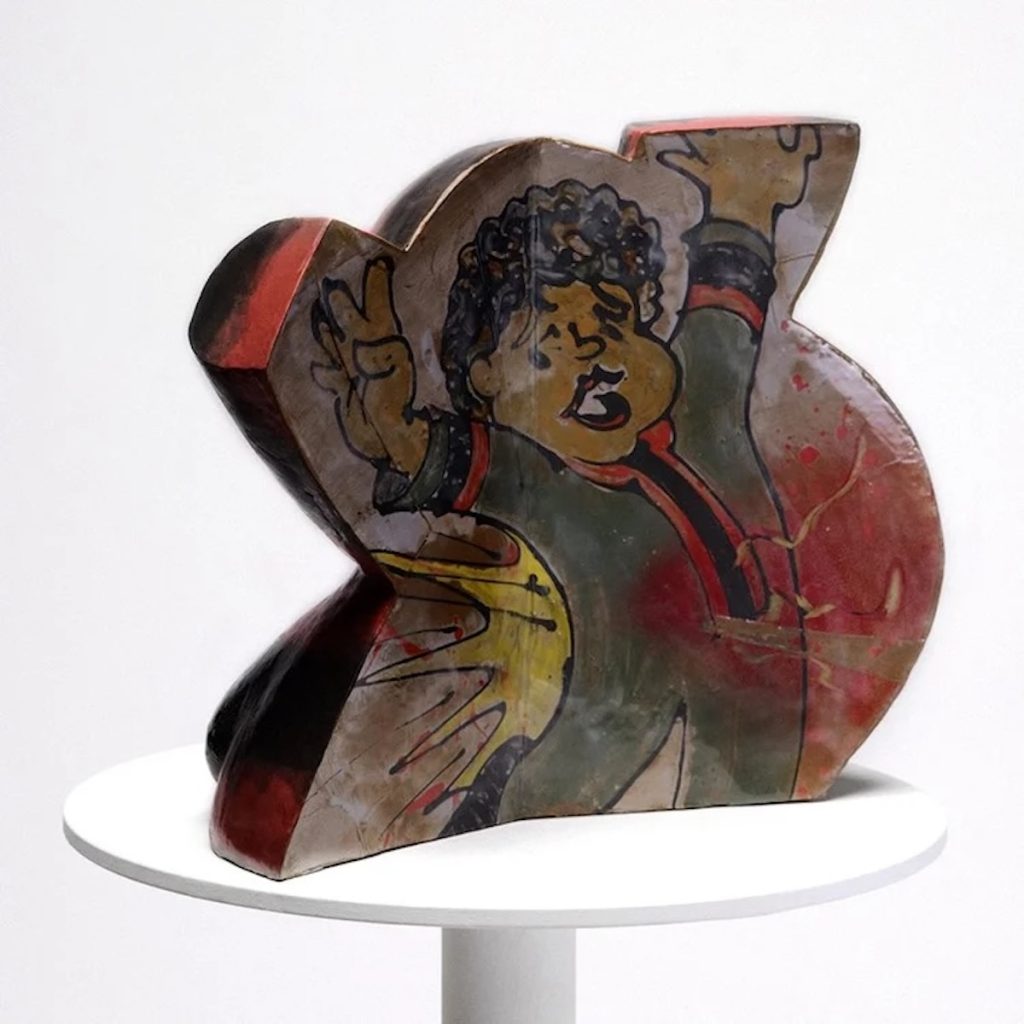
Malcolm Mobutu Smith’s “Signals” at Wexler Gallery is the kind of show that rewards a second look. From across the room, the ceramic sculptures in Signals read as bold, color-saturated objects — playful in shape, generous in scale, confident in their claim on space. Move closer and the work shifts. Imagery pulled from mid-century American periodicals surfaces beneath the glaze — caricatures and racial stereotypes from the 1930s through 1950s embedded in forms that initially present as pure abstraction. The tension between what you see at a distance and what reveals itself up close is the engine of the entire exhibition, on view through May 22.
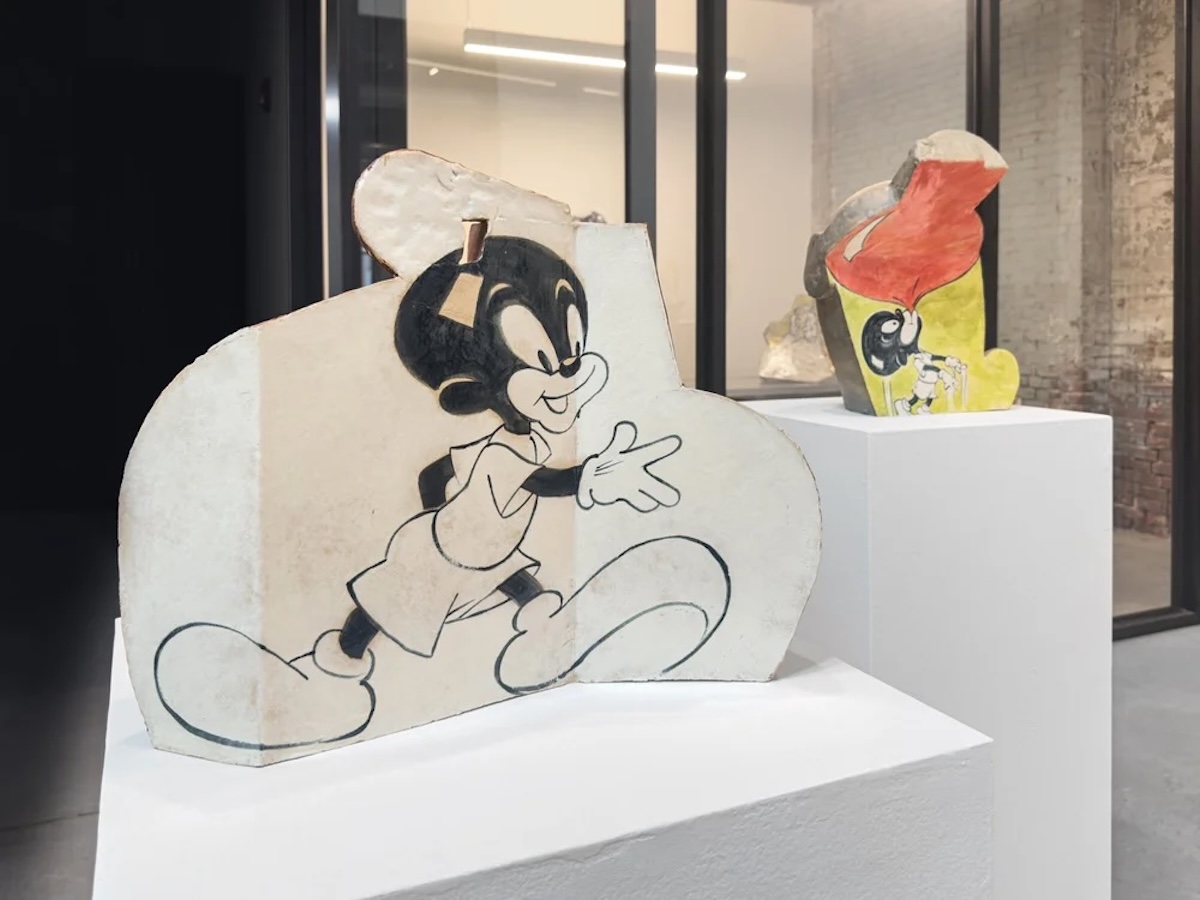
(background) “Love Lifts Us Up” 2010. Stoneware, slip and glaze. 17 x 14 x 15 inches.
Smith came up as a graffiti artist working between Flint and Philadelphia before turning to clay, and that origin story is visible in everything here. Graffiti is about claiming space — putting your name on a surface that was not offered to you. In ceramics, Smith transfers that impulse to the vessel, treating cups, bottles, and vases not as functional objects but as bodies that can carry meaning, confrontation, and beauty simultaneously. He works across wheel-thrown precision and hand-building, pulling from hip hop, jazz, comic books, and African sculptural traditions without hierarchy. Nothing sits in a single lane.
What You Will Find at Malcolm Mobutu Smith at Wexler Gallery
The show spans 2010 to 2026, which gives it a documentary quality — you can track Smith’s response to the last decade and a half of American life, from cautious optimism to something darker and more urgent. Works like No More Words place figures of pride and resilience directly against offensive historical imagery, forcing the viewer to hold both at once. Other pieces go fully non-objective, subverting traditional pottery with blocked openings, exaggerated volumes, and surfaces that pile on decoration until the form tips from functional to confrontational. Smith calls them “overtly decorative embellishments to utilitarian vase forms,” which is a polite way of saying he is breaking the rules on purpose.
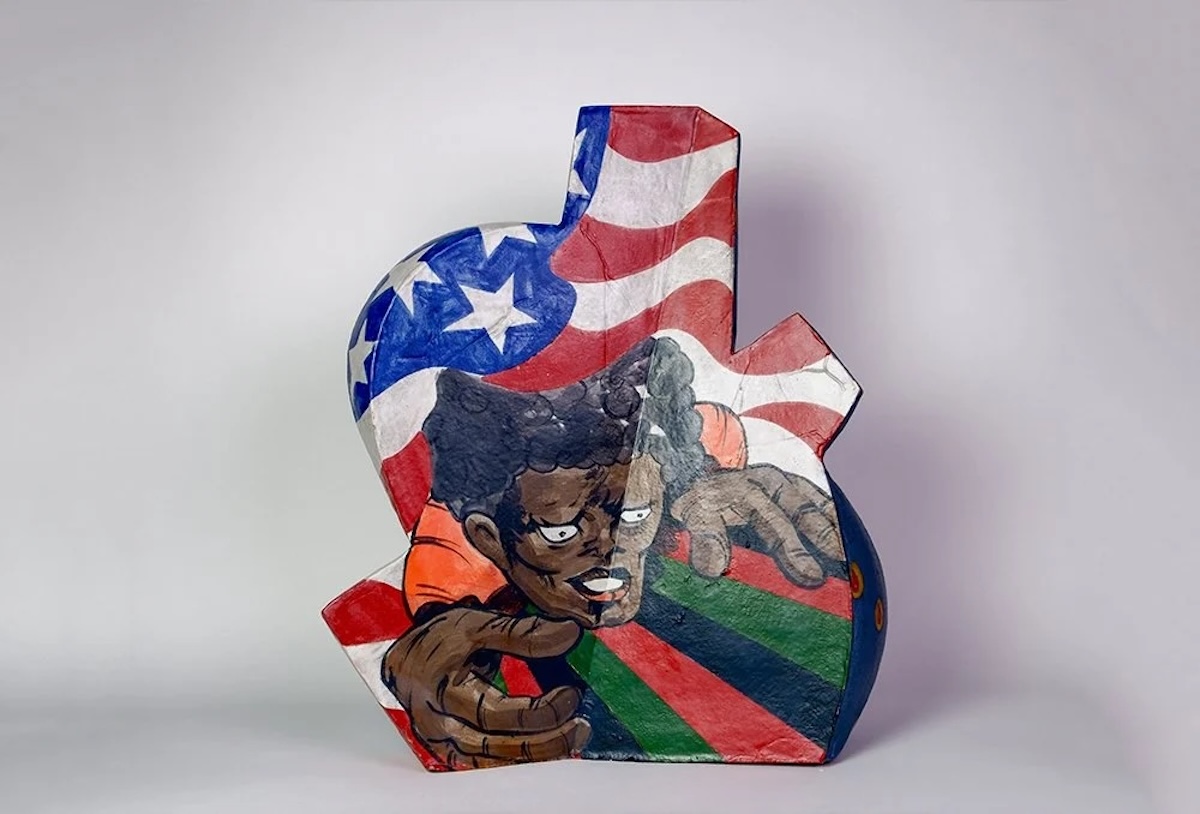
Many works in the exhibition embed racially charged imagery appropriated from American periodicals of the 1930s through 1950s — imagery that emerges only upon close inspection. These historical caricatures are recontextualized to confront enduring systems of racism and cultural trauma. In works like No More Words, figures associated with pride and resilience stand in direct tension with offensive representations, producing a charged dialogue between shame, resistance, and survival. Smith’s background as a graffiti artist working from Flint to Philadelphia — where marking space functioned as a declaration of presence — informs every piece. In clay, that impulse shifts from the street to the vessel, which he claims as a shared cultural form.
Philadelphia’s gallery calendar has been running hot all year, and Signals earns its place by doing something most ceramic exhibitions do not attempt — using the vessel as a political and cultural instrument without sacrificing the visual pleasure of the object. The work is seductive and uncomfortable in equal measure, and it does not ask you to choose between the two. Malcolm Mobutu Smith at Wexler Gallery runs through May 22.
Images: Courtesy of Wexler Gallery
About Post Author

Discover more from dosage MAGAZINE
Subscribe to get the latest posts sent to your email.
