
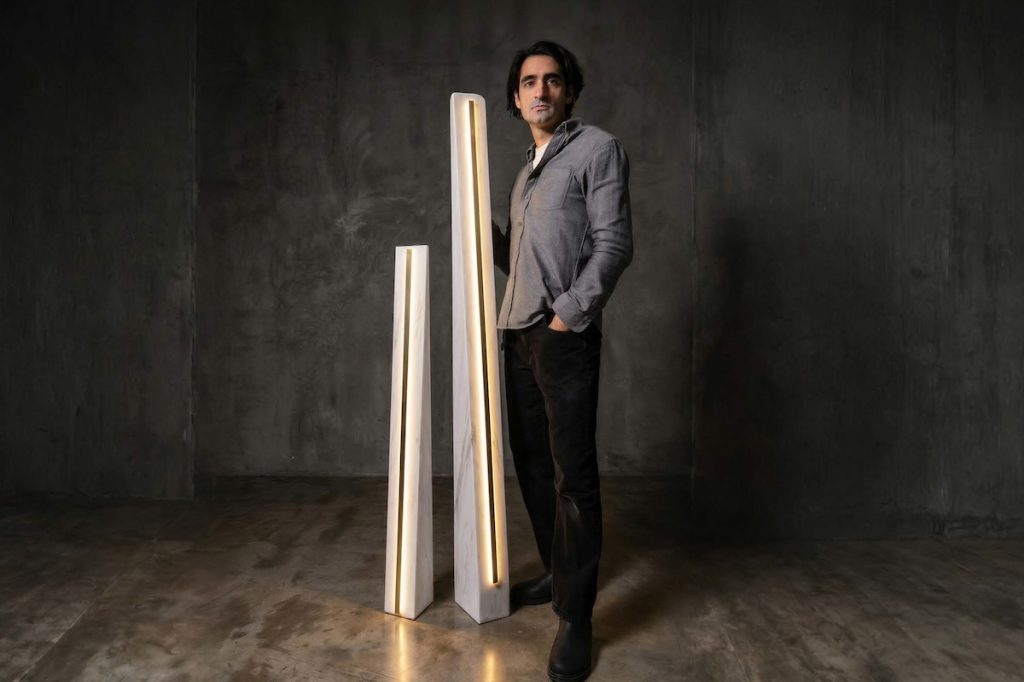
Marcus De Paula works with stone formed hundreds of millions of years ago and drives light through it. His first major solo exhibition, at Wexler Gallery in Fishtown, opens this Thursday, June 11 — and it’s one of the more genuinely ambitious shows to land in Philadelphia this summer.
Marcus De Paula and the Materials of Deep Time
Marcus De Paula is a Brazilian-American sculptor based in New York whose practice is built on a specific tension: the collision between geological time and the present moment. He works with volcanic rock, travertine, alabaster, and granite — materials formed hundreds of millions of years ago — carving them into geometric forms and embedding lines of radiant light directly into the stone.
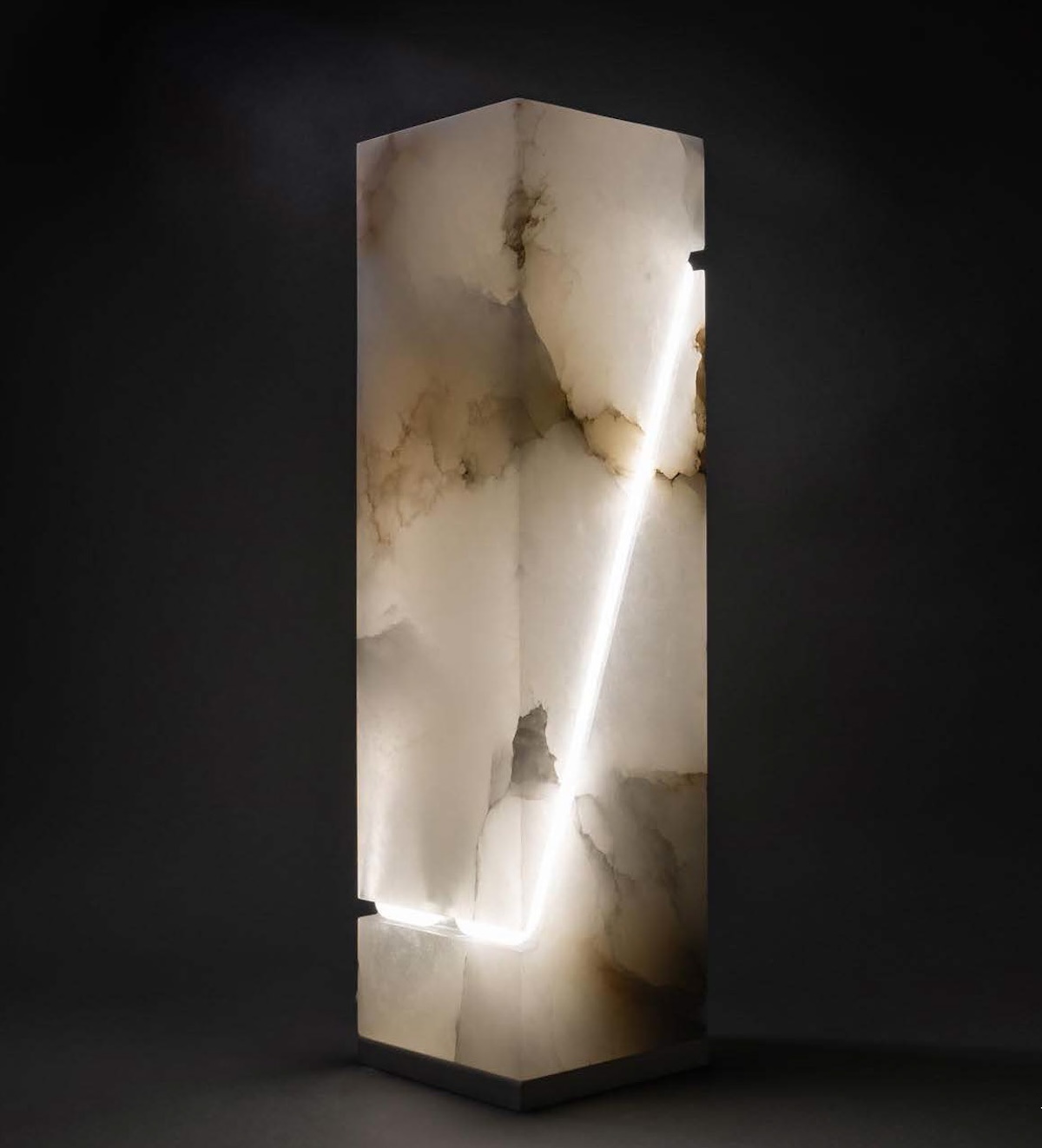
IO Prime, a 72-inch column of Roman travertine bisected by a warm plane of LED light, anchors the new work. Named after Jupiter’s volcanically active moon, the sculpture reveals the stone’s layered mineral history from within.
De Paula was born in California in 1986. His father directed missions to Mars at NASA; his mother is a painter and ceramicist. Growing up between space imagery and studio practice gave his work a dual register — cosmological in its references, technically exacting in its execution. He also brings more than fifteen years of experience designing lighting for theater, film, and live performance. In his sculptures, light is not decorative. It is structural.
Marcus De Paula’s Titan Gets Its First Indoor Installation
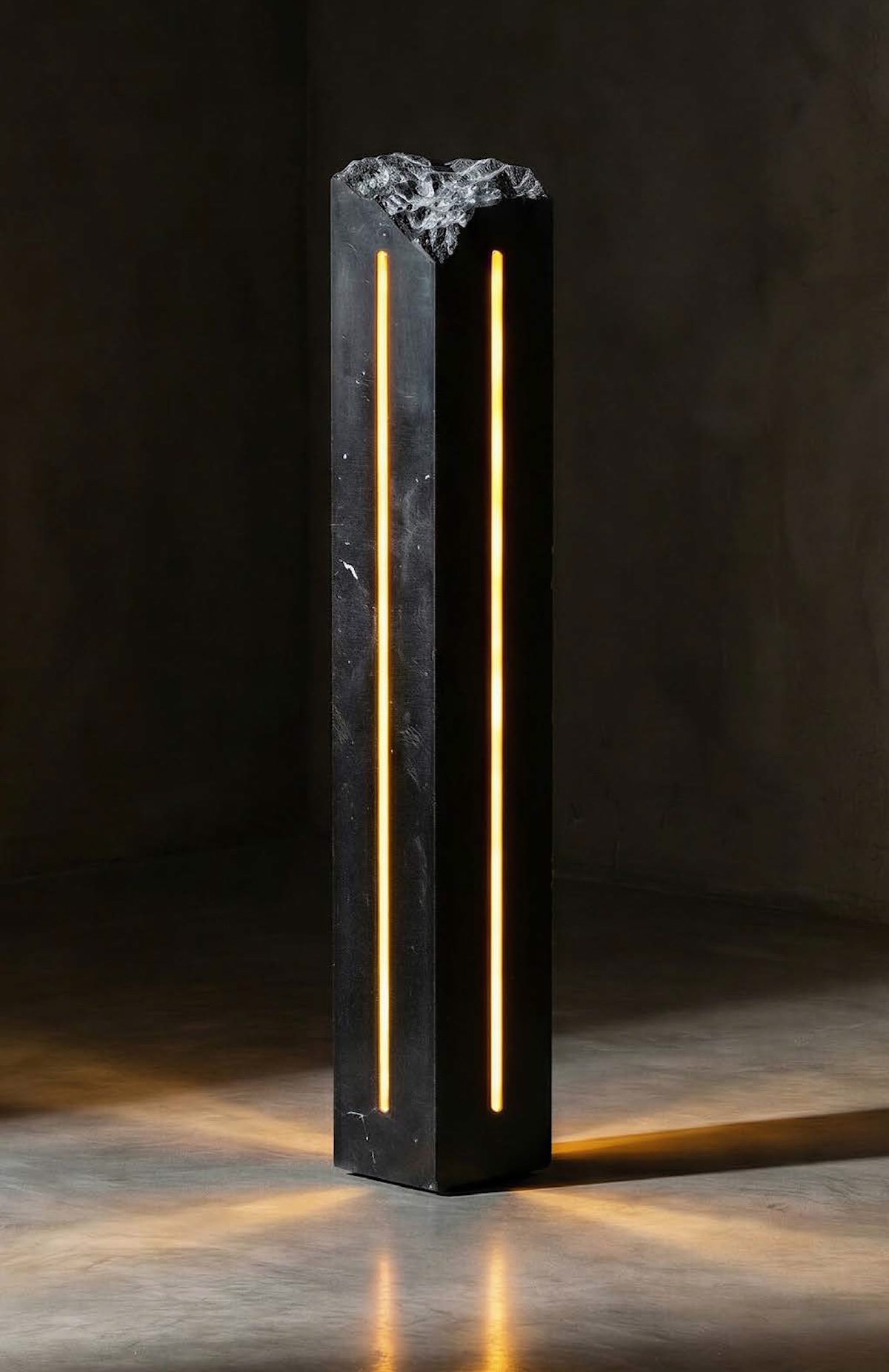
The exhibition’s centerpiece is Titan, a 10-foot-tall, 3,000-pound structure carved from 500-million-year-old Zimbabwean black granite first installed at Burning Man in 2022. Two monumental stone pillars frame a narrow passage leading into a mirrored interior chamber — by day the reflective surfaces capture the surrounding environment, and by night the chamber fills with light. Interstice marks the work’s first indoor presentation, a fundamentally different spatial encounter than the Black Rock Desert offered.
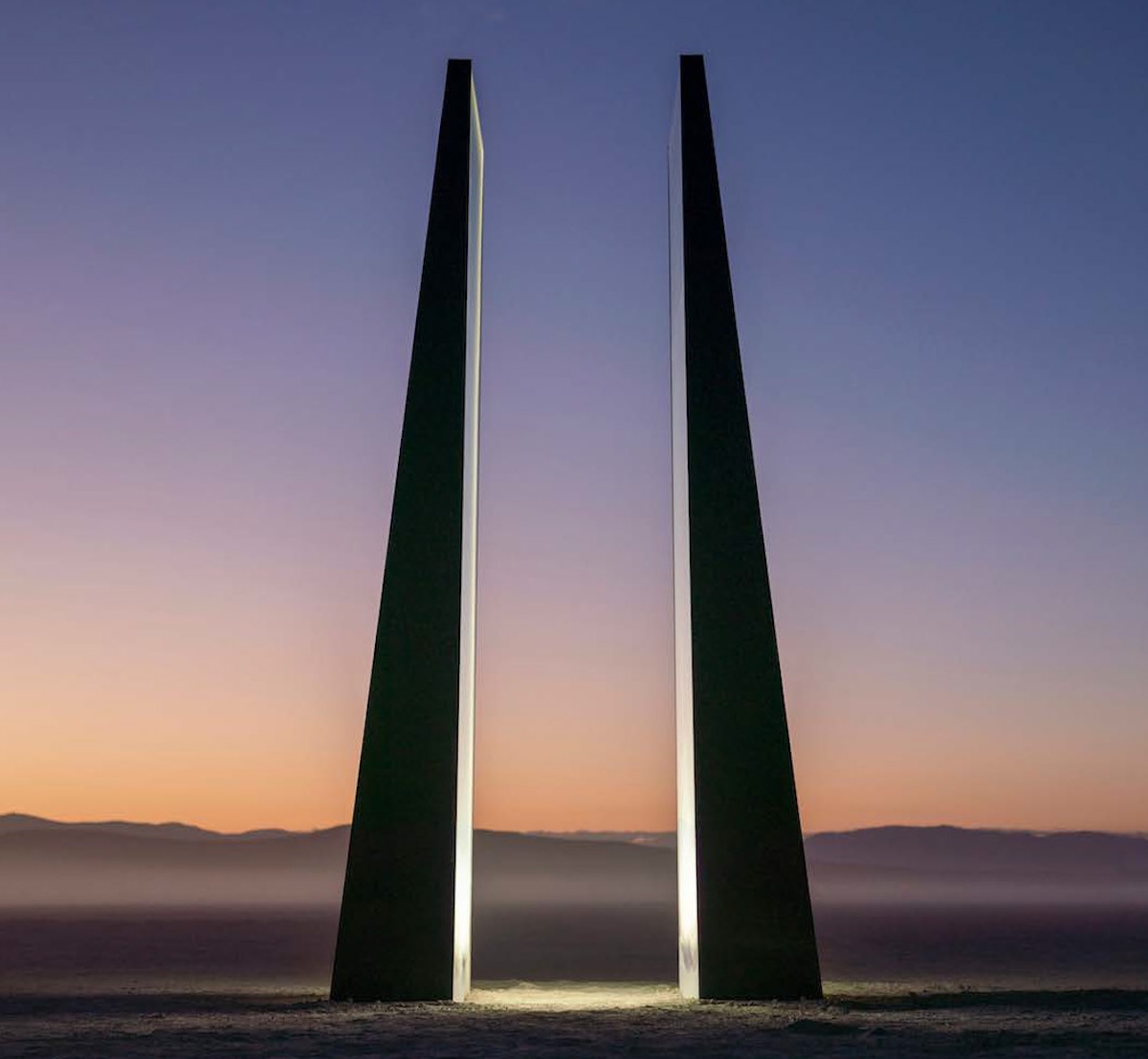
New works extend De Paula’s cosmological naming convention. Theia, carved from black Nero Fossile marble with gold-leaf-lined channels, takes its name from the Titaness of brilliance and radiant light. Asteria, also in black marble but lit from within by blue LED, is named after the Titaness of the night sky and nocturnal prophecy.
The gallery frames the full installation as a cosmic sculpture garden — each work positioned as a spatial event within a larger constellation of objects.
The Parabola Series: Marcus De Paula Without Light
A distinct thread in the exhibition is the Parabola Series, which operates on entirely different terms. These resin works — ranging from small desk-scaled editions to 40×80-inch wall panels — do not emit light. They function as lenses, bending, refracting, and distorting ambient light to produce effects that resist easy explanation.
Moving around them, surfaces shift and dissolve; what reads as depth from one angle flattens entirely from another. The mechanism is never revealed, the illusion never resolved — a different kind of perceptual encounter than the luminous stone works positioned elsewhere in the show.
De Paula has described the broader project plainly: “These sculptures are imagined as relics from another civilization, but in truth they are about our own. They ask what we leave behind, what survives us, and whether there is anything in our brief existence that might endure against the scale of geological and cosmic time.”
Whether Wexler Gallery’s Frankford Avenue space can hold a work that debuted in the Nevada desert is the exhibition’s sharpest question. The transition from playa to gallery doesn’t diminish work of this scale — it recontextualizes it, making the stone’s mass legible against walls and other viewers in ways the open desert could not.
Interstice opens Thursday evening with a public reception and runs through August 14.
About Post Author

Discover more from dosage MAGAZINE
Subscribe to get the latest posts sent to your email.
